

Global Minimum Tax Meets M&A: Recent Developments and Transaction Risks
The global minimum tax has become a key consideration in M&A transactions, as a change in group ownership alone may fundamentally alter a target company's tax position. This article examines how the minimum tax and related recent developments, including the OECD's Side-by-Side package, affect due diligence, business valuation and purchase price considerations, as well as the contractual allocation of risks.
1. Introduction
For corporate groups whose financial year corresponds to the calendar year, the deadline for filing the minimum tax return in Germany expired for the first time on 30 June 2026.¹ The global minimum tax has long since arrived in corporate practice.
Initial experience with practical implementation shows that the filing obligations relating to the global minimum tax are not comparable, in terms of effort and scope, to conventional tax filing obligations. In particular, the cross-jurisdictional collection and analysis of extensive data from various group companies presents many corporate groups with significant challenges, the handling of which requires close cooperation between tax departments, accounting and IT.
Against this background, it is also unsurprising that the minimum tax is already the subject of a number of court proceedings in Germany. A recent judgment of the Cologne Tax Court (Finanzgericht Köln) shows just how fundamental the related legal questions can be:² a corporate group sought to challenge the obligation to file a minimum tax return by way of a preventive declaratory action (vorbeugende Feststellungsklage). In support of its action, and alongside arguments based on EU law, the group pointed in particular to the disproportionate effort and costs associated with preparing the tax return. The Cologne Tax Court dismissed the action as inadmissible but granted leave to appeal to the German Federal Tax Court (Bundesfinanzhof), which must now determine, under case reference I R 12/26, whether a taxpayer may challenge the obligation to file a minimum tax return pre-emptively, or whether it must first file a return and subsequently challenge the resulting tax assessment. Pending a decision of the Federal Tax Court, corporate groups have no option, for the time being, but to file their returns on time, since preliminary legal protection is also unlikely to be granted.
The debate over the legal foundations of the minimum tax therefore does not relieve transaction practice, at least not for now. Buyers and sellers must accordingly prepare for a tax regime that not only brings substantial compliance and liability risks but may also become the subject of fundamental litigation. For M&A transactions, the question is therefore no longer whether the minimum tax must be taken into account, but how any resulting risks can be identified, assessed and appropriately allocated between the parties.
2. Background and Features of the Minimum Tax relevant for Transactions
The global minimum tax forms part of the second pillar (Pillar 2) of the OECD's project against base erosion and profit shifting (BEPS). It was implemented in Germany through the Minimum Tax Act (Mindeststeuergesetz, "MinStG") and is intended to ensure that international corporate groups, as well as large domestic groups, are subject to effective taxation of at least 15 per cent in every state in which they operate.³ The Minimum Tax Act applies only where a corporate group reported consolidated revenue of EUR 750 million or more per year in the consolidated financial statements of its ultimate parent entity in at least two of the four financial years immediately preceding the relevant financial year.⁴ Whether a company is itself subject to the minimum tax further depends on whether it is to be regarded as a constituent entity of that corporate group, which is generally determined by whether the company must be included in the consolidated financial statements of the ultimate parent entity under the applicable accounting standards.⁵ In addition to the regular constituent entities of a corporate group, and irrespective of legal form, joint ventures or permanent establishments may also, under certain circumstances, be subject to minimum tax.⁶
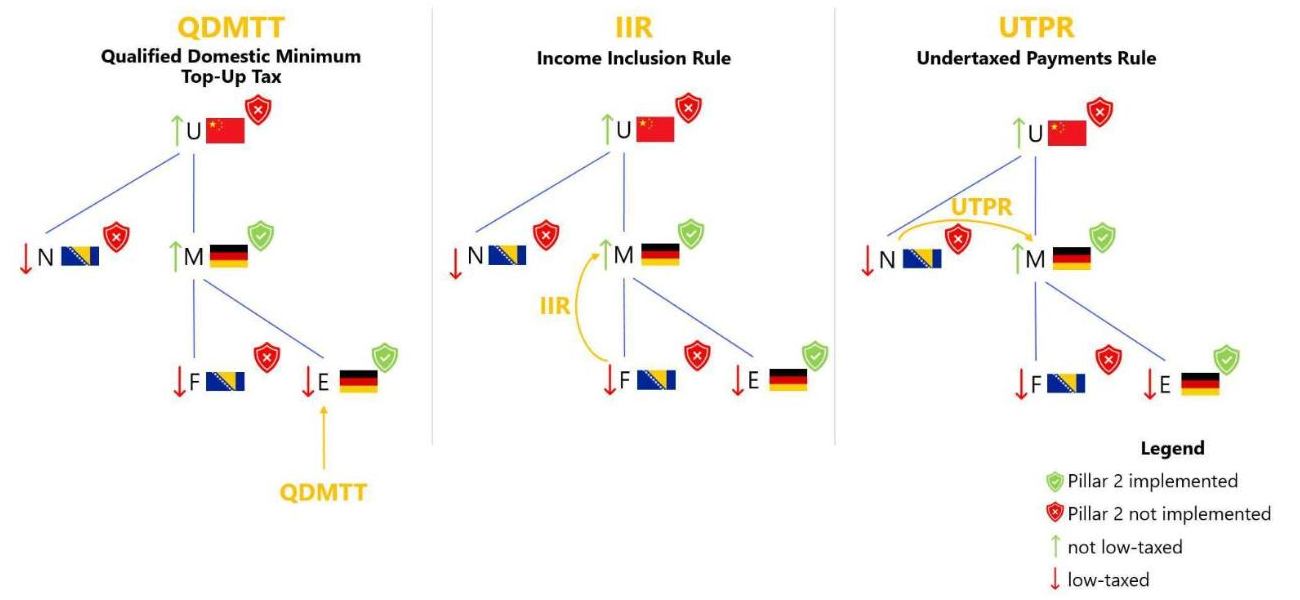
The minimum tax differs from conventional income taxes in a number of respects. For example, its starting point is not necessarily the national accounting standard or the tax balance sheet of the relevant company, but rather the accounting data used for the consolidated financial statements, which may also be based on a foreign accounting standard.⁷ On this basis, an effective tax rate is determined for the constituent entities of a corporate group in each state.⁸ Where this rate falls below 15 per cent in a given country, this is referred to, for Pillar 2 purposes, as low taxation, which may trigger minimum tax. The various scenarios in which minimum tax may arise under the German implementation of Pillar 2 can be illustrated as follows:
Fig. 1 The Global Minimum Tax in Germany – 3 Ways of Imposing Top-up Tax
 Source: Own illustration
Where a German constituent entity is itself subject to low taxation, the minimum tax is levied on that constituent entity itself based on the so-called Qualified Domestic Minimum Top-Up Tax (QDMTT). In the left-hand part of the diagram, this would result in a tax charge at the level of E.⁹
If, however, the low taxation occurs at a constituent entity located in a jurisdiction that has either not implemented Pillar 2 at all or has not introduced a QDMTT, the tax resulting from low taxation may be levied at that entity's German parent company based on the Income Inclusion Rule (IIR). In the middle part of the diagram, this means that the tax on the low-taxed F is levied at M, because Bosnia and Herzegovina has not yet implemented the Pillar 2 rules.
Finally, the tax could even be levied at a German sister company where both the low-taxed sister company and the common parent company are resident in jurisdictions that have not implemented Pillar 2. In these scenarios, top-up taxation applies based on the Undertaxed Payments Rule (UTPR). In the right-hand part of the diagram, this means that the tax on the low-taxed N is levied at M, because neither Bosnia and Herzegovina nor China has so far implemented Pillar 2.¹⁰
The minimum tax therefore looks not only at the individual constituent entity, but also at its integration into the group as a whole.¹¹
In addition, the minimum tax rules provide for certain reliefs or exceptions, referred to as safe harbours.¹² Where their requirements are met, the computational burden can often be significantly reduced, or the top-up tax amount for part of the corporate group in a given state can even be treated as nil in its entirety. Since some of the requirements for safe harbours are tied to the circumstances of the entire corporate group, the group to which a company belongs and the location of its ultimate parent company play a key role in determining their applicability.
It is precisely this group-wide perspective that is of central importance in M&A transactions. This is because a target's minimum tax position depends not solely on its own earnings and tax payments, but is regularly also influenced by the earnings and tax positions of other companies within the same group that are resident in the same jurisdiction. The information required for this purpose often lies outside the transaction perimeter and is therefore frequently not fully available to the target. Consequently, from an acquirer's perspective, it is often not possible to assess minimum tax risks solely on the basis of the target's tax returns, tax assessment notices and accounting records.
A further complication is that the group membership relevant for minimum tax purposes changes as a result of the transaction. Upon leaving the seller group and joining the purchaser group, not only the calculation of the effective tax rate but also, for example, the applicability of safe harbours may change. It is also possible that the purchaser group falls within the scope of the minimum tax only as a result of the acquisition of the target. Therefore, a target's previous minimum tax position generally cannot be carried forward to the period after closing.
Consequently, historical risks arising from membership of the seller group, on the one hand, and future liabilities within the purchaser group, on the other, must be examined separately. This can have implications for due diligence, the insurability of risks, the business valuation and the contractual allocation of risks.
3. Recent Developments: The Side-by-Side Package
Especially in its initial phase, the global minimum tax is characterised by considerable dynamism. In particular, the necessary interplay between the various national tax systems requires ongoing international coordination and regular adjustments to the regulatory framework.
The most comprehensive development of the global minimum tax to date is the OECD's "Side-by-Side" package, published this year and agreed by 147 members of the OECD/G20 Inclusive Framework on BEPS.¹³ It extends existing safe harbours and introduces new relief measures.¹⁴ The centrepiece of the new rules is the eponymous Side-by-Side Safe Harbour. Under this provision, corporate groups whose ultimate parent entity is resident in a country with a minimum taxation system recognised by the OECD may, under certain conditions, be exempted from key components of the global minimum tax.
Currently, only corporate groups with an ultimate parent entity in the United States benefit from the new Side-by-Side Safe Harbour, since, to date, only the United States has been recognised as a country with a minimum taxation system approved by the OECD.¹⁵ The Side-by-Side rules should therefore be understood, at their core, as a concession to the US government, which had demanded that the US corporate groups be generally exempt from foreign taxation. At this point, it remains to be seen whether the new Side-by-Side Safe Harbour will continue to serve solely the interests of the United States in future, or whether further jurisdictions, such as China, will be included in its scope. However, Qualified Domestic Minimum Top-Up Taxes (QDMTT) as well as certain reporting and disclosure requirements generally remain in effect even when the Side-by-Side Safe Harbour applies.
For M&A transactions involving the U.S., it is therefore particularly crucial that the availability of this new relief is contingent on membership in a specific corporate group. If a target is acquired from a qualifying group, the safe harbour may cease to apply going forward upon closing. Low-taxed profits of the target or its subsidiaries that had not previously triggered minimum tax within the seller group may, as a result, give rise to an additional tax burden within the purchaser group for the first time. Conversely, an acquisition by a qualifying corporate group may result in the elimination of minimum tax that had previously been applicable. A target's tax burden may thus change in the future solely due to the change of control, even though its operating activities and national tax rules remain unchanged.
While the new safe harbour rules do reduce the tax burden and administrative effort in certain cases, they create additional dependencies on the respective corporate structure for transaction practice. As part of due diligence, it is therefore not only necessary to examine whether the target has benefited from a safe harbour to date. Equally important is the question whether the requirements for the safe harbour will continue to be met after closing. The findings from this analysis should be taken into account not only in the business valuation, but also in the contractual allocation of any minimum tax risks.
4. Minimum Tax in Due Diligence
As a result, the minimum tax can significantly broaden the scope of tax due diligence.
Looking back, the first step is to determine whether the target fell within the scope of the minimum tax prior to the transaction. In doing so, it will be necessary to examine the target's previous minimum tax returns and reports, the underlying calculations and any application of safe harbours. In this context, it is particularly important that the processes and control mechanisms (compliance systems) implemented by the target deliver structured and reliable results and are internally consistent. In addition, it will be necessary to examine whether minimum tax may have already arisen in the past – perhaps even without being detected – and whether any tax amounts that have been assessed have already been paid.
Conducting such due diligence requires, above all, interdisciplinary expertise in tax law and accounting; however, it also demands sufficient practical experience with transactions, and therefore cannot simply be classified as part of the conventional tax due diligence. This also regularly raises challenging questions for tax advisers, as the global minimum tax relies on a separate calculation framework that differs significantly from the determination of taxable income.
A further complication is that not all relevant information is typically available. Unlike with conventional tax risks, it is generally not sufficient to review the target's own tax returns, tax assessment notices and accounting records. Since the minimum tax is tied to the circumstances of the entire corporate group and the combined tax position of the companies within a country, data from other companies of the seller group typically becomes relevant as well. This data often falls outside the transaction perimeter and is not available to the target itself, or only available to a limited extent. The seller, in turn, will not be able or willing to disclose sensitive information about its remaining group, which poses challenges for a purchaser, particularly with regard to the insurability of any risks, as insurers generally require an appropriate level of due diligence.
This applies in particular to carve-out transactions. Where the minimum tax has so far been calculated centrally at the level of the seller group, the target company being carved out may lack both its own historical calculations and the necessary systems and data to perform such calculations. This raises the question of whether the target will be able to obtain the relevant information on its own. Therefore, especially in carve-out transactions, the functionality of existing compliance systems plays a crucial role and must be a focus of due diligence.
If a risk cannot be conclusively assessed due to a lack of group-wide data, various supplementary mechanisms may be considered as part of the due diligence process: On the one hand, these may include expert sessions with the seller group's tax department or tax adviser, during which processes and available information are explained in greater detail. On the other hand, additional information rights for the purchaser for the period following closing may be considered, although experience shows that a seller is likely to react rather cautiously to such a request.
In addition, with an eye toward the future, it is necessary to assess what minimum tax burden may arise within the purchaser group going forward. While due diligence focused on the past is primarily relevant for indemnities and other contractual protection mechanisms, due diligence focused on the future can have a direct impact on future cash flows and therefore on the valuation of the target. Furthermore, the question of the future tax burden may also be an issue that needs to be considered as early as the transaction structuring phase. The minimum tax thus broadens the scope and depth of due diligence beyond the traditional review of historical tax liabilities to include a forward-looking analysis of the tax situation following closing.
5. Impact on Valuation and Purchase Price
It is precisely this last aspect that means the issues identified during the due diligence regarding the minimum tax must not only be taken into account when drafting the agreement (see section 6 below in this regard), but may also, in some cases, have a direct impact on the purchase price or affect the valuation of the target.
For the valuation of a target, it should therefore generally be examined in detail what minimum tax burden is likely to arise following the transition to the purchaser's group. In this context, particular consideration should be given to consolidation with other companies in the purchaser's group in the relevant tax jurisdiction, as well as possible changes in the applicability of safe harbours.
Where this analysis indicates that minimum tax is likely to be payable on a permanent basis following the acquisition, this should be reflected in the financial model and, consequently, in the future cash flows relevant to the valuation. The same applies to additional ongoing costs associated with collecting and processing the necessary data, as well as complying with reporting and disclosure requirements. This is all the more true for carve-out transactions, where the target has previously relied on the seller group's centralised systems and resources and will therefore need to establish its own processes and structures after completion. While this cannot be attributed to the seller, it is nevertheless advisable to factor this into the business plan at an early stage.
In addition to future developments, it is necessary to identify historical minimum tax risks that should be taken into account when determining the purchase price or addressed separately in the sale and purchase agreement. The appropriate solution depends primarily on whether the identified risk can be reliably quantified. Where reliable quantification is possible, a corresponding reduction in the purchase price may be considered. If, on the other hand, significant uncertainties remain, a contractual safeguard will generally be the more appropriate course of action, raising the question of how any risks can be appropriately allocated between the parties in the sale and purchase agreement.
6. Risk Allocation and Related Drafting
The starting point for an appropriate allocation of tax risks is generally the definition of taxes agreed in the sale and purchase agreement. In German practice, this definition is often modelled on section 3 of the German General Tax Code (Abgabenordnung) and covers conventional taxes, tax-related ancillary charges such as interest or late-payment surcharges, and comparable foreign concepts. The agreed risk allocation typically provides for a cut-off date up to which taxes are deemed to have been caused by, and are generally to be borne by, the seller, while taxes caused from that date onward are generally to be borne by the purchaser.
This traditional approach regularly leads to two problems. First, the typical definition of taxes does not, by its very nature, encompass all taxes levied under the Pillar 2 regulations. In Germany, this is particularly relevant to a specific provision under which constituent entities whose top-up tax amounts are allocated to the group parent entity (Gruppenträger) are generally obliged to indemnify the group parent entity.¹⁶ This can result in the seller's group parent entity having a civil-law indemnification claim against the target that continues to exist even after the acquisition. In substance, this claim is comparable to a conventional tax. As has been the case to date in relation to indemnification claims under cost-sharing agreements (that are in particular relevant in the context of VAT groups) or claims among joint and several debtors under section 426 of the German Civil Code (Bürgerliches Gesetzbuch), this must be captured by an appropriate definition of taxes, so that an indemnification claim against the seller arises where the seller caused the indemnification claim under the Minimum Tax Act before the relevant cut-off date.
Second, the Minimum Tax Act provides that necessary corrections are not made in the financial year in which the underlying error was made, but rather in the financial year in which the need for correction is identified.¹⁷ Here too, the tax clause must allow for allocation by reference to the cut-off date. It should therefore ensure that the seller remains liable for such increases in the minimum tax that are only taken into account in a financial year after completion, but that are based on an error that arose prior to the cut-off date.
In addition, the typical set of tax warranties should be supplemented to include certain aspects specific to minimum tax. In practice, this has so far primarily involved statements regarding membership, or non-membership, of a corporate group subject to Pillar 2, regarding the timely and proper fulfilment of reporting and disclosure deadlines and regarding the correct application of safe harbours. In some cases, however, the issuance of such warranties is refused on the basis that the selling company is not the group parent entity and that such warranties could, at most, be issued by such group parent entity, which is, however, not a party to the sale and purchase agreement. The content, scope and insurability of such warranties are currently regularly the subject of contract negotiations and discussions with insurers and brokers; a uniform market practice has not yet emerged.
Finally, particular importance attaches to information and cooperation obligations following completion. This is because the preparation or correction of minimum tax reports and returns may require information from the seller group even after the target has been acquired by the purchaser. Conversely, the seller may also have to rely on data from the target where the target was still part of the seller's corporate group during part of the relevant financial year. The sale and purchase agreement should therefore specify which party is responsible for providing the necessary information, who is responsible for preparing and filing returns and corrections and how the parties will cooperate in the event of tax audits or appeal proceedings.
Finally, during contract negotiations, the question of whether potential minimum tax risks can be covered by W&I insurance or by a specific tax insurance policy is frequently raised. While discussions on this topic suggest that insurers are generally willing to underwrite such risks, successful coverage has so far remained the exception in practice.
This is because coverage under a W&I policy typically requires that the relevant risk remains unknown, i.e. not yet identified or specifically recognised. Nevertheless, it must be demonstrated that the risk in question was sufficiently examined as part of the due diligence process. While tax insurance is, in principle, somewhat more flexible in this regard than W&I insurance, an insurer will, even in that context, still expect the risk to have been sufficiently examined and assessed. In practice, the lack of group-wide data in particular makes it difficult not only to assess the risk, but also to determine its insurability.
The specific features of the minimum tax must therefore be consistently taken into account not only when assessing and evaluating tax risks, but also when allocating them under the terms of a contract.
7. Conclusion
The global minimum tax has long since become part of transaction practice. Since its effects depend not only on the target company's own circumstances but also, to a significant extent, on its integration into the respective corporate group, even a transition from the seller's group to the purchaser's group can change the minimum tax position for the future. Historical risks and future liabilities must therefore be examined separately and taken into account in due diligence, business valuation and contract drafting.
The standardised review approaches and conventional tax clauses used to date are often insufficient for this purpose. Buyers and sellers should therefore factor minimum tax considerations into the transaction process at an early stage and, in particular, address the availability of group-wide information and the need for cooperation and information after closing.
Sources
Cf. section 95(2) in conjunction with section 75(3), second and third sentences of the German Minimum Tax Act (Mindeststeuergesetz, "MinStG").
Cologne Tax Court (Finanzgericht Köln), decision dated 24 June 2026 – 3 K 2419/25, appeal pending before the German Federal Tax Court (Bundesfinanzhof) under case reference I R 12/26.
Act implementing Council Directive (EU) 2022/2523 on ensuring a global minimum level of taxation for multinational enterprise groups and large-scale domestic groups in the Union and further accompanying measures dated 21 December 2023, Federal Law Gazette 2023, Part I No. 397, as last amended on 22 December 2025, Federal Law Gazette 2025, Part I No. 353.
Cf. section 1(1) MinStG.
Cf. section 4(1) MinStG.
Cf. section 1(2) MinStG for joint ventures and section 4(2) MinStG for permanent establishments.
Cf. sections 15 et seqq. MinStG, in particular section 15(1) MinStG.
Cf. sections 53 and 54 MinStG. By way of exception, the effective tax rate of certain investment entities is determined separately under section 72 MinStG.
In Germany, such tax is owed by M as group parent entity (section 3(1), third sentence MinStG); E is obliged to indemnify M based on a compensation claim established by law (section 3(6) MinStG).
On the Income Inclusion Rule (IIR), cf. sections 8 et seqq. MinStG; on the Undertaxed Payments Rule (UTPR), cf. sections 11 et seqq. MinStG; and on the Qualified Domestic Minimum Top-Up Tax (QDMTT), cf. sections 90 et seqq. MinStG. Where the Qualified Domestic Minimum Top-Up Tax does not fully cover the top-up tax amount determined under the minimum tax rules, the remaining amount may still be levied based on the Income Inclusion Rule or the Undertaxed Payments Rule, cf. section 54(2) MinStG.
Cf. in particular sections 3 and 4 MinStG.
Cf. in particular sections 78 et seqq. MinStG.
OECD/G20 Base Erosion and Profit Shifting Project, Tax Challenges Arising from the Digitalisation of the Economy – Global Anti-Base Erosion Model Rules (Pillar Two), Side-by-Side Package, available at: www.oecd.org/content/dam/oecd/en/topics/policy-sub-issues/global-minimum-tax/side-by-side-package.pdf.
The package comprises, in particular, the Side-by-Side Safe Harbour, the UPE Safe Harbour, the Simplified ETR Safe Harbour, the Substance-based Tax Incentives Safe Harbour, and an extension of the Transitional CbCR Safe Harbour; see the previous footnote.
Under the current Central Record, only the United States qualifies for the Side-by-Side Safe Harbour, www.oecd.org/en/topics/sub-issues/global-minimum-tax/central-record-of-legislation-with-transitional-qualified-status.html#qualified-sbs-regimes.
Cf. section 3(6), first sentence MinStG.
Cf. section 52(1) MinStG.


