

The Art of Letting Go: How a Carve-out Unlocks the Potential of a High-Performing Mid-Sized Organization
Carve-outs are more than legal separations or operational disentanglements. They represent a strategic turning point. This is especially true when a business unit is separated from a global corporate group and transformed into an independent, internationally active mid-sized company.
Carve-outs are more than legal separations or operational disentanglements. They represent a strategic turning point. This is especially true when a business unit is separated from a global corporate group and transformed into an independent, internationally active mid-sized company.
In such situations, success is not defined solely by executing a smooth Day-1. It depends on whether the newly created organization is able to operate independently, competitively and sustainably in the long term. A critical success factor lies in the ability to consciously let go of structures, processes and cost models that no longer fit the future organization.
At the same time, a Carve-out creates a unique opportunity to actively optimize EBIT by identifying and eliminating unnecessary cost drivers that are often deeply embedded in corporate structures but add limited value to the mid-sized standalone business.
This article draws on a Carve-out of a Commercial Vehicles business that transitioned from a large corporate environment into an independent company with approximately 1,500 employees worldwide. The Carve-out took place within a span of 12 months out of which the first five months were utilized to plan the execution and get the engine running, while the last seven months were focused on actively separating the business. It illustrates how letting go across structures, processes and mindsets can become a catalyst for efficiency, speed and strategic focus.
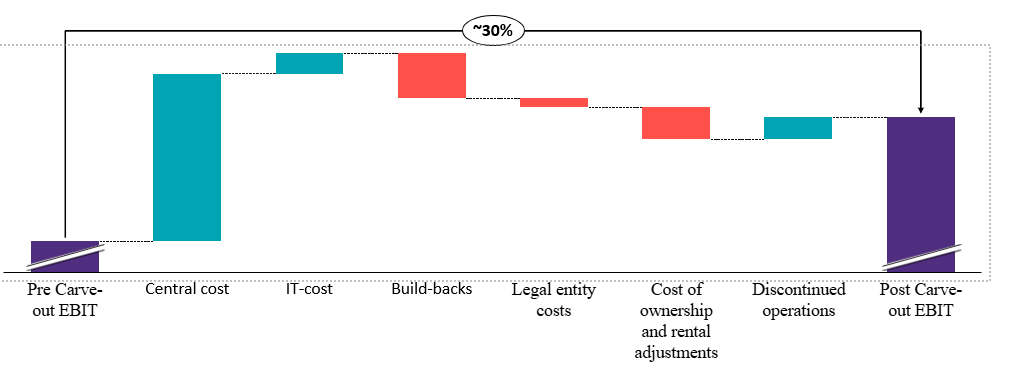
While qualitative transformation narratives provide important context, the impact of a Carve-out becomes evident when reflected in financial performance. In this case, the combined effect of the defined improvement levers translates into a significant increase in EBIT.
The Art of Letting Go: How a Carve-out Unlocks the Potential of a High-Performing Mid-Sized Organization
 Source: Grant Thornton AG
The largest contribution is captured in the “Central cost” block, which aggregates the effects of multiple transformation pillars. This includes the reduction of corporate cost structures (par. 1), the simplification of workflows and governance (par. 2), the outsourcing of non-core functions (par. 3), and the discontinuation of legacy brand-related cost burdens (par. 6). Together, these measures represent the structural shift from a corporate cost logic to a fit-for-purpose mid-sized setup.
Corporate Cost Structures has an impact beyond this initial block and is further reflected in subsequent adjustments, including “Build-backs”, “Legal entity costs”, “Cost of ownership and rental adjustments”, and “Discontinued operations”. These elements capture necessary corrections and reallocations that arise when transitioning to a fully independent operating model.
Outsourcing also partially feeds into “Build-backs”, as certain capabilities need to be selectively rebuilt in-house to ensure effective vendor steering and operational continuity.
The “IT-cost” bar directly corresponds to paragraph 4, reflecting the financial impact of simplifying and modernizing the technology landscape.
Diffused Accountability is not explicitly represented as a separate element in the waterfall. While it is a critical enabler for many of the quantified improvements, its impact materializes indirectly across multiple levers and remains primarily visible in qualitative performance gains rather than isolated financial effects.
1. Goodbye Corporate Cost Structures – From Scale to Fit
Large corporate organizations are designed for scale, control and risk mitigation. While these characteristics provide stability, they often come with cost structures that are not suited to a mid-sized business operating in competitive markets.
From an EBIT perspective, these structures frequently include hidden or indirect cost drivers – such as inflated overhead allocations, duplicated roles, underutilized assets or corporate service charges – that dilute profitability without contributing proportionally to value creation.
As part of the executed Carve-out, the global footprint and cost base of the business were thoroughly reviewed. This resulted in:
Consolidation of locations,
Closure of non-strategic sites,
Streamlining of organizational layers and overhead functions,
Separation from corporate IT and simplification of the IT landscape.
Over a 12-month period, we took a holistic approach by reviewing the P&L, analyzing cost allocations, and assessing the installed base in each country (e.g., new business vs. after-sales) to identify potential improvement levers. Based on these insights, we decided to reduce the number of sites by half (from 40 to 20) and consolidate operations into selected regional hubs. To ensure continued supply in “exit countries” – i.e., markets where we no longer maintain a direct presence – we established partnerships with service providers, distributors, and agents to fulfill contractual obligations and meet customer demand.
Costs that were previously embedded in corporate structures became transparent and manageable. This transparency enabled a systematic identification and removal of non-value-adding cost drivers, e.g. multiple decision layers or process overheads, directly contributing to EBIT improvement. The separation process created a unique opportunity to redesign the cost base in line with the new company’s size, strategy and growth ambitions.
Letting go of historically grown structures was not an exercise in austerity. It was a prerequisite for building a lean, resilient organization capable of competing independently.
2. Goodbye Complex Workflows – Mid-Sized Processes as Competitive Advantage
Beyond cost structures, the Carve-out triggered a fundamental shift in how decisions are made. Corporate environments often rely on multi-layered approval processes, extensive documentation and matrix structures. While these mechanisms serve governance purposes, they can slow down execution and reduce accountability.
Such complexity is not only an operational burden – it is also a hidden cost driver. Delays, inefficiencies and excessive coordination efforts translate directly into higher operating costs and reduced EBIT margins.
The newly established organization used the Carve-out as a reset point to redesign its processes:
Significantly reduced approval levels,
Clear end-to-end ownership instead of fragmented responsibilities,
Direct decision-making at management level.
Pre-Carve-out, six different people were required to approve of a single workflow, e.g. to start the recruiting process for an open position. Following the Carve-out, the number of required approval levels was reduced to two.
The result was not a loss of control, but a governance model tailored to the organization’s actual needs. This led to fewer delays, less interdependency and more ability to act. Decision-making became faster and accountability clearer.
By eliminating process-driven inefficiencies, the organization was able to reduce indirect costs and unlock additional EBIT potential – showing that simplicity can be faster and more profitable.
In this context, mid-sized processes emerged as a genuine competitive advantage.
3. Goodbye In-House Non-Core Functions – Outsourcing as Strategic Enabler
A further key element of the transformation was the deliberate decision to outsource non-core functions. While large groups often operate extensive shared service centers, such structures are rarely efficient or necessary for independent mid-sized companies. Fewer economies to scale mean that outsourcing might be the more efficient and cost-effective alternative.
From an EBIT optimization perspective, in-house non-core functions often represent significant fixed cost blocks with limited flexibility. Transforming these into variable, demand-based cost structures can materially improve operating leverage.
Partnering with specialized external providers can enable companies to:
Reduce internal complexity,
Leverage scalable, best-practice solutions,
Ensure high levels of quality and compliance from Day-1.
In addition, outsourcing standardized activities creates the opportunity to systematically leverage best cost countries through the provider’s delivery model. Rather than building and managing own offshore structures, companies can benefit from established shared service centers and talent pools, combining cost efficiency with process maturity and resilience.
In this Carve-out, specific corporate functions (e.g. Accounting, HR services and payroll, and Tax compliance and advisory services) were outsourced for all locations and entities. This allowed a more efficient handover and knowledge transfer in order to secure business continuity within a tight timeline. Furthermore, the decision strengthened communication and reporting on KPIs which made the tracking of outsourcing success possible. Through the selected outsourcing partner, shared service centers in India, China and Poland were leveraged for standardized activities, ensuring consistent service delivery while optimizing the overall cost base.
This shift not only simplifies the organization but also removes structural cost inefficiencies, contributing directly to a more sustainable and scalable EBIT profile.
Outsourcing was not primarily driven by cost considerations. Instead, it was a strategic choice to allow management and key functions to focus on the core business, customers and future growth.
4. Goodbye Oversized IT – Rightsizing the technology landscape
IT is often one of the most complex and cost-intensive areas in a Carve-out. Large corporate IT landscapes typically evolve over many years, resulting in highly customized, fragmented and oversized system environments. While these setups may serve the needs of a global organization, they are rarely aligned with the requirements of a mid-sized standalone business.
From an EBIT perspective, legacy IT environments frequently include significant inefficiencies, e.g., high infrastructure costs, redundant applications, low system utilization or expensive licensing models – all of which contribute little to operational value.
Carve-outs can create a unique opportunity to fundamentally rethink the IT setup through a targeted rightsizing approach. Instead of replicating the existing corporate IT landscape, the organization can deliberately challenge which systems are truly required to support its future operating model.
In our recent scenario, this resulted in:
Transition from on-premise infrastructure to scalable cloud-based solutions,
Elimination of non-essential and redundant applications,
Replacement of legacy systems with standardized, cost-efficient solutions,
Reduction of complexity in the overall IT architecture.
Rather than “copying and pasting” the legacy environment, only business-critical applications were migrated, while others were either consolidated or fully eliminated. This significantly reduced both the cost base and the operational complexity of IT.
At the same time, the move to the cloud increased flexibility and scalability, allowing the organization to align IT costs more closely with actual business needs. Fixed infrastructure costs were transformed into variable and demand-driven expenses, which led to improved overall cost transparency and control.
IT rightsizing was therefore not just a technical necessity, but it turned out to be a strategic lever. Rightsizing enabled the organization to build a lean and future-oriented IT landscape that supports growth while contributing directly to a structurally improved EBIT profile.
5. Goodbye Diffused Accountability – Culture Change as Cornerstone of the Carve-out
In addition to structural and process-related changes, the Carve-out required a fundamental cultural shift. In the former corporate setup, responsibilities were often fragmented across functions and hierarchy levels. Tasks were frequently passed on rather than owned, leading to inefficiencies, delays and a lack of clear accountability.
Diffused accountability is not just a cultural issue – it is also an economic one. Lack of ownership often leads to duplicated work, slower execution and unresolved inefficiencies, all of which act as hidden cost drivers impacting EBIT.
The transition to an independent mid-sized organization created an opportunity for a cultural reset, characterized by:
Clear end-to-end ownership instead of fragmented responsibilities,
Defined roles and decision rights aligned with the new organizational model,
Empowered leadership teams with the accountability for outcomes rather than activities,
Reduced escalation and handovers, foresting faster issue resolution.
This culture of ownership became a key driver of efficiency and execution speed. By embedding accountability into roles, governance and leadership behavior, the organization was able to translate structural simplification into tangible performance improvements. Culture change was therefore not treated as a soft topic, but as a critical component of the overall Carve-out success.
As inefficiencies were reduced and execution improved, the organization benefited from a structurally stronger EBIT performance – proving that culture can be a direct lever for financial impact.
When asking the workforce at the beginning of the Carve-out, most employees would respond that they are skeptical to the process and do not understand the decision. However, after a while, the decision was made and almost everyone was looking forward to building a new company with its own identity.
6. Goodbye Legacy Brand – Unlocking Identity, Independence and Growth
Beyond structures, processes and cost models, one of the most visible and symbolic “goodbyes” in a Carve-out is the separation from the legacy brand. For many organizations, the corporate brand has been a long-standing anchor – associated with reputation, trust and market recognition. However, it often also comes with constraints that limit the strategic flexibility of a newly independent mid-sized company.
From an EBIT perspective, legacy brand affiliations can entail significant cost burdens, particularly in the form of ongoing licensing fees, brand usage charges or mandatory marketing contributions. These cost structures are typically designed for large corporate ecosystems and may not reflect the value they provide to a standalone entity.
In the observed Carve-out, the decision to discontinue the use of the corporate brand resulted in:
• Elimination of recurring brand licensing costs,
• Full ownership of brand positioning and messaging,
• Increased flexibility in addressing new customer segments and markets,
• Ability to build a differentiated value proposition aligned with the new strategy.
At the same time, the introduction of a new brand enabled the organization to redefine how it presents itself to customers, partners and employees. Without the constraints of corporate branding guidelines, the company was able to create a more focused, agile and market-oriented external presence.
This shift also opened the door to new commercial opportunities. In some markets and segments, the legacy brand had created implicit limitations – whether due to positioning, pricing expectations or channel conflicts. Establishing a new brand allowed the organization to overcome these barriers and access previously untapped sales channels and partnerships.
Internally, the new brand became a catalyst for cultural transformation. It provided employees with a clear signal that the organization was entering a new phase – one defined by independence, ownership and entrepreneurial thinking.
7. Conclusion: The Art of Letting Go
A successful Carve-out is not defined by separation alone. Its true measure lies in the organization that emerges once the transition is complete. Letting go of corporate cost structures, overly complex processes, legacy brand and the assumption that all functions must be kept in-house is essential – but not sufficient on its own.
Achieving this outcome requires conscious design choices across scope, timing and operating model. In particular, the way a Carve-out manages the transition from corporate dependency to full stand-alone capability has a material impact on both short-term stability and long-term value creation. Rather than a binary choice, speed and independence represent a continuum of strategic options. Accelerated timelines often necessitate Transitional Service Agreements (TSAs) to safeguard business continuity, providing temporary access to corporate systems, processes and resources. Longer execution phases, by contrast, reduce reliance on TSAs and create additional room to redesign structures, simplify processes and implement sustainable solutions from the outset. The key is not to avoid TSAs per se, but to use them deliberately and with a clear exit strategy – ensuring they support continuity without locking the organization into legacy complexity, cost structures or branding constraints.
At its core, a Carve-out can be a powerful lever for EBIT optimization. By systematically identifying and eliminating unnecessary cost drivers, organizations can significantly improve profitability while building a more agile and focused operating model.
Equally important is the shift in cultural patterns. Replacing diffused accountability with clear ownership and responsibility enables organizations to fully realize the benefits of leaner structures and faster decision-making and a clearly defined market identity.
Equally important is saying goodbye to cultural patterns that no longer serve the business. Replacing diffused accountability with clear ownership and responsibility enables organizations to fully realize the benefits of leaner structures, faster decision-making and a newly defined market identity.
The art of letting go lies in creating space:
for lean cost structures aligned with strategic priorities,
for sustainable EBIT improvement through elimination of non-value-adding costs,
for pragmatic, mid-sized governance and decision-making,
for simplified systems and processes,
for a culture of ownership and accountability,
for a distinct and independent brand identity enabling new market access,
for a focused organization that concentrates on what truly matters.
When approached holistically, a Carve-out becomes more than a transition exercise. It becomes a unique opportunity to build a resilient, agile and future-ready organization–designed not for the past, but for the challenges ahead.


